Scaffolding Costs for a Belgian Renovation: Why There's No Single Price Per Week (and How to Budget Anyway)
Why your search for a 'scaffolding price per week' comes up empty
Type "scaffolding price per week" into a search bar, and you'll find forums, old blog posts and conflicting numbers — but no official Belgian tariff. That's not an oversight. Scaffolding isn't sold off a shelf at a fixed weekly rate, the way a skip rental or a cement mixer might be.
Every job is different: façade height, access, wall surface, duration, local labour availability. A contractor pricing a three-storey terraced house on a narrow street faces a different logistics problem than one working a detached villa with open access. Add in that most European scaffolding firms serve commercial sites alongside residential ones, and a single list price would misrepresent almost every real quote.
That's the honest starting point here: there's no number to look up. There's a cost structure to understand, so you can read a quote and know whether it makes sense.
Key takeaways
- Buying scaffolding costs roughly USD 1,000–10,000 per setup; renting runs USD 15–50 a day — figures from Credence Research, not localised to Belgium or the euro.
- Renting cuts storage and maintenance costs, which Credence Research estimates can save up to 20% of total cost of ownership — a saving that accrues most to companies using scaffolding repeatedly, not to a one-off renovation.
- A shortage of skilled scaffolders in parts of Europe can delay erection and dismantling and push labour costs up, regardless of material prices.
- Steel was Europe's largest scaffolding material segment in 2025; supported (ground-based) scaffolding was the leading type (Market Data Forecast).
- No official Belgian weekly scaffolding tariff exists — pricing is set contractor by contractor, via written quote.
Why is there no single 'price per week' for scaffolding?
Three forces explain why quotes vary so much from one contractor to the next, rather than converging on a published rate.
Renting is a growing preference, not a fixed rule
Across Europe, renting scaffolding rather than buying it has become the growing preference among contractors, driven by lower upfront costs, flexibility for projects with varying needs, and the elimination of storage costs, according to a Europe Scaffolding Market report by Credence Research. A rental fleet lets a contractor scale scaffolding resources up or down per job — but it also means the price you're quoted reflects that contractor's current rental agreements, not a market-wide rate.Residential jobs compete for the same crews as commercial sites
Commercial applications held 48.3% of the Europe scaffolding market in 2025, according to Market Data Forecast's Europe Scaffolding Market report. Homeowners effectively compete with office towers, retail fit-outs and public infrastructure projects for the same pool of scaffolders and equipment. A residential façade job doesn't disappear from the queue — it just sits behind contracts that are larger and, from a supplier's point of view, more predictable.The labour bottleneck
A third dynamic compounds the first two. A shortage of skilled scaffolders in parts of Europe affects pricing regardless of which contractor you call — the mechanics of that bottleneck, and how to plan around it, are covered in detail further down.From a daily rate to a weekly budget: a hedged calculation
The only hard cost figures available in the market research reviewed here are not Belgian, and they're not quoted in euros. Credence Research's Europe Scaffolding Market report puts the average cost of purchasing scaffolding at USD 1,000 to USD 10,000 per setup, and renting the same setup at USD 15 to USD 50 per day. Those figures are denominated in US dollars, aren't localised to Belgium or any single Western European country, and aren't broken down by scaffold size or façade height — Belgian contractors quote in euros, so treat the USD figures only as a rough order of magnitude to convert at the current exchange rate, not a ready-made budget.
Multiplying the daily rental figure by seven days gives an illustrative weekly range of roughly USD 105 to USD 350. That is not a tariff. It's a rough order of magnitude for a generic rental setup, useful mainly as a sanity check: if a quote for a modest residential façade comes in wildly above or below that converted range, it's worth asking the contractor what's driving the difference — scaffold size, access difficulty or duration.
The only reliable number for your specific project is a written, itemised quote, broken down by setup, rental period and dismantling.
Buy or rent for a single renovation: the real breakeven question
Whether buying or renting comes out ahead depends on utilization rate, how long the equipment will be held, and storage and maintenance costs — not on a blanket rule for either option. Renting scaffolding eliminates storage and maintenance expenses and, according to Credence Research, can save up to 20% of total cost of ownership — but that saving accrues most to companies using scaffolding repeatedly, not to a homeowner doing it once. For a contractor running scaffolding across dozens of sites a year, high utilization can tilt the math toward ownership over time; for an occasional user, the storage and maintenance burden of owning equipment tends to outweigh any long-run saving.
For a single renovation, the real question isn't "is it cheaper to buy or rent scaffolding" in the abstract. It's: how many weeks will the scaffolding actually stand, and at what point does the daily rental cost cross the threshold where owning the equipment would have been cheaper?
Consider a hypothetical, illustrative scenario: a basic setup bought at the low end of the USD 1,000-10,000 range, against the same setup rented at USD 15-50 a day. At the cheapest end of both ranges, renting for a few weeks is clearly cheaper than buying outright. Stretch the same hypothetical project to several months, and the gap narrows — though a homeowner still has to store, maintain and eventually dispose of equipment they'll likely never use again.
That's the question worth putting to a contractor directly: not "what's your rate", but "at what project length would buying have made more sense than what you're charging me to rent". The answer tells you whether the quote reflects a one-off job or a long-haul setup.
Matching scaffold type and material to a residential façade job
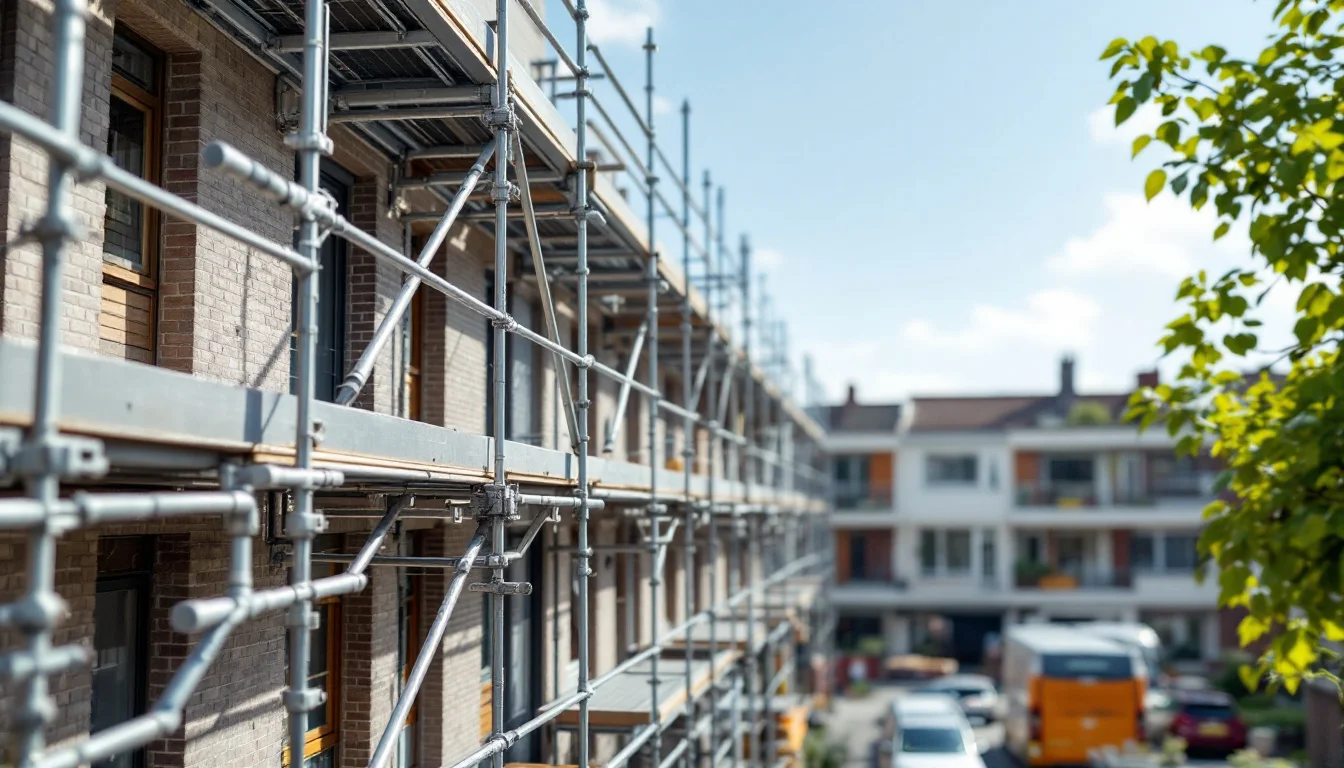
Getting an accurate quote starts with describing the job correctly — not just "scaffolding for my house", but the type of access the work actually needs. Credence Research's Europe Scaffolding Market report distinguishes three main types.
| Scaffold type | Support mechanism | Typical residential use | Mobility |
|---|---|---|---|
| Supported | Built up from the ground, structurally self-supporting | General façade work, insulation, render, roofline access | Fixed for the job's duration, versatile across heights |
| Suspended | Hangs from an overhead structure such as a roof anchor | Painting, maintenance, window installation on taller buildings | Can be raised or lowered along the façade |
| Rolling | Mounted on casters | Short, localised jobs — gutters, single windows, spot repairs | Moves freely around the site |
Material choice is a separate conversation, and it affects both cost and suitability:
- Aluminium is lightweight and easy to assemble and transport — useful for smaller jobs or tight access.
- Wood is cost-effective and easy to customise on site.
- Steel is durable and favoured for heavy-duty, long-term work.
What's actually driving scaffolding demand — and prices — in Western Europe
Residential façade work doesn't happen in isolation. It sits inside a much larger renovation wave. Growth in European scaffolding demand is attributed to large-scale façade renovation programmes, infrastructure modernisation, urban densification, modular and lightweight aluminium systems, and BIM-based scaffold planning, according to Market Data Forecast's Europe Scaffolding Market report.
The scale of that wave is notable: roughly 11% of European buildings are renovated each year, though only 1% achieve significant energy savings — a European Commission figure cited in Credence Research's Europe Scaffolding Market report. Most of that renovation activity needs scaffolding at some point, which keeps demand, and competition for crews, persistently high.
The market itself keeps growing: valued at USD 16.93 billion in 2025 and estimated at USD 17.88 billion in 2026, it's projected to reach USD 27.68 billion by 2034, a 5.61% annual growth rate over 2026-2034, according to Market Data Forecast. A separate Credence Research estimate puts Western Europe's share of the regional market at approximately 40% of revenue, while Market Data Forecast separately names Germany as the largest single national contributor. Belgium sits inside this wider Western European market rather than operating as a separate pricing zone — part of why no isolated Belgian tariff exists in current market data.
The hidden line item: labour availability, not materials
If one fact should change how you plan a renovation timeline, it's this one: a shortage of skilled labour in parts of Europe can delay scaffolding erection and dismantling, and it raises labour costs, because companies struggle to recruit experienced scaffolders, according to Credence Research.
In practice, this means the gap between quotes from two contractors often has less to do with the scaffolding itself and more to do with crew availability. A contractor with scaffolders booked solid for the next six weeks will either quote a premium to fit you in or push your start date back.
The practical response is simple: ask for lead times in writing, not just a price. Build a schedule buffer into your renovation plan — a week or two of slack between finishing one trade and the scaffolding going up for the next. It won't change the market, but it avoids finding out about the delay the week work was due to start.
FAQ
Is there an official weekly scaffolding price list in Belgium? No. Current market research doesn't include a published Belgian — or even euro-denominated — weekly tariff for scaffolding. Pricing is set contractor by contractor, based on the job. When you do get a quote, check that it's itemised by setup, rental period, dismantling and lead time — that breakdown tells you more about the real cost than any published rate could.
Why do scaffolding quotes vary so much between contractors? Mostly because of crew availability, not equipment cost. A simple diagnostic: ask each contractor for their lead time alongside their price. A much cheaper quote paired with a far later start date usually signals a contractor squeezed by the same shortage of skilled scaffolders affecting the rest of the market, not a difference in scaffold quality or material cost.
Does renting always beat buying for a single home renovation? Not necessarily. It depends on how long the scaffolding needs to stand. Ownership's cost advantage builds up over repeated use; for a one-off job, the real question is whether your project's duration is long enough to approach that breakeven point — worth asking a contractor directly rather than assuming rental always wins.
What should I tell a scaffolding contractor to get an accurate quote? Give them the façade height, the type of access needed (ground-supported for general work, suspended for upper-level painting or window jobs, rolling for small spot repairs), the expected duration of the work, and any material preference — steel for heavy or long jobs, aluminium for lighter, shorter ones.
Conclusion: the quote is the real price list
In a market with no public scaffolding tariff, the written, itemised quote functions as the only reliable price signal available to a homeowner. That's unlikely to change soon, but the way quotes are built might: BIM-based scaffold planning and modular aluminium systems, both already shaping demand across Western Europe, are starting to make scaffolding proposals more itemised and easier to compare line by line. Whether that trend reaches small residential jobs as consistently as it has larger commercial ones remains an open question worth putting to the next contractor who sends you a quote.