Green Roofs: Why the Load-Bearing Check Decides Your Cost Before the Plants Do
The number that matters isn't €/m² — it's kg/m²
Most people shopping for a green roof start with the plants: sedum mats, wildflower mixes, maybe a proper roof garden with shrubs. The sales conversation usually follows, landing somewhere between €70 and €150 per m² — a broad span that includes everything from basic sedum mats to full intensive roof gardens — according to the Dutch price guide published by home-services platform Zoofy (2026). That range is real, but it's also the wrong starting point.
The number that actually decides your budget is how many kilograms per square metre your existing roof structure can carry. A sedum roof needs 60 to 150 kg/m² of load-bearing capacity; a roof garden needs 150 to 500 kg/m², per the same Zoofy guide. If your roof falls short, everything that follows — the membrane, the drainage, the substrate — gets built on top of a structural upgrade you didn't budget for.
One note before the numbers: the price bands below come from a Dutch market guide, not a Belgian one. Treat every euro figure here as a reference point to sanity-check a local quote, not as a Belgian list price.
Key takeaways
- Load-bearing capacity sets the ceiling: 60–150 kg/m² for a sedum system, 150–500 kg/m² for a full roof garden (Zoofy, 2026).
- If the structure can't carry that load, reinforcement adds €90–150/m² before any vegetation goes in.
- An untreated bitumen base layer often isn't root-resistant and may need a new PVC or EPDM membrane first, at €45–100/m² — though modified bitumen membranes (APP/SBS) can already meet root-resistance standards, so the existing layer should be checked before assuming a replacement is needed.
- Even where the structure holds, a Toronto-area cost-benefit analysis found green roofs cost more overall for private building owners once the upfront outlay is weighed against energy savings — public incentives are usually what tips the balance.
What does a green roof actually weigh, and why does it come first?
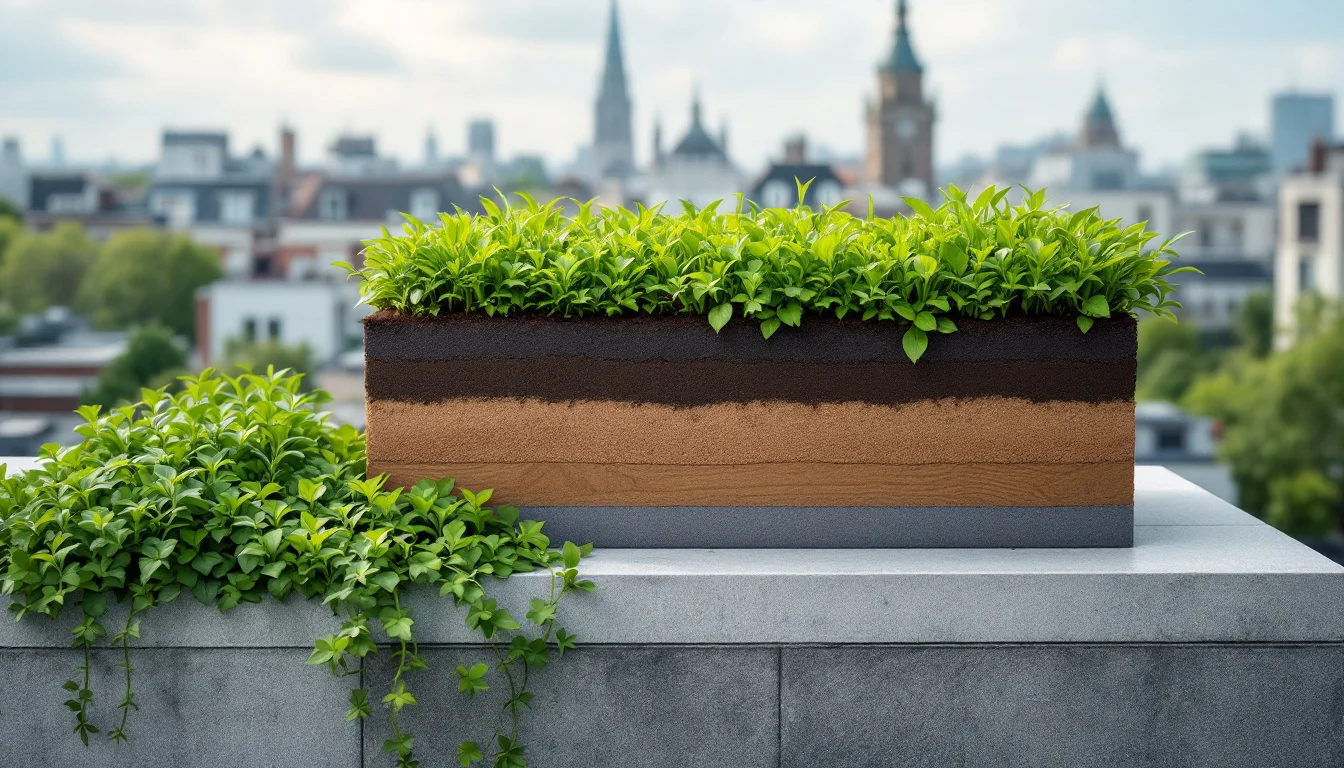
A green roof is not a layer of soil on a slab. It's a stacked system — membrane, drainage, filter fabric, substrate, plants — and once it's saturated with rainwater, it's heavy. That's why the load-bearing figures matter more than the vegetation catalogue: a sedum system at 60–150 kg/m² is within reach of many existing flat roofs, but a roof garden at 150–500 kg/m² is a different structural proposition entirely, closer to what you'd design for from the start than retrofit onto an old deck (Zoofy, 2026).
Pitch matters almost as much as load. A flat roof is the ideal base case. Past 35 degrees of slope, the system needs extra anchoring to stop it sliding; beyond roughly 45–60 degrees, most standard systems no longer work, though specialised solutions — honeycomb grids, mechanical anchoring, erosion-control layers — can still green a steep roof in specific cases, even if that's far from a standard installation (Zoofy, 2026). So the two gatekeepers — weight and angle — have to be cleared before a single cost conversation about sedum versus perennials makes sense.
There's a reason the system is built this heavy in the first place: a sedum roof can retain 50 to 70% of the rainwater that falls on it, according to the same guide — the figure is documented for sedum systems specifically, though the underlying principle (saturated soil is heavier than dry soil) applies to roof gardens too. That retention is the whole point of the drainage and substrate layers underneath the plants — and it's also exactly why those layers need a structure strong enough to hold saturated soil, not just dry soil, through a wet winter.
The layer stack, in the order it actually gets built
A green roof isn't installed as one job — it's a sequence, and each step either confirms you're fine or adds cost. Per Zoofy's 2026 breakdown, the order runs:
- Load-bearing assessment of the existing roof structure.
- Reinforcement, if the assessment shows the structure can't take the planned system's weight.
- A root-resistant waterproofing membrane.
- A drainage layer to move excess water off the roof.
- A filter layer to keep substrate from clogging the drainage below it.
- The growing substrate.
- The vegetation itself — sedum, wildflower mix, or garden planting.
So by the time anyone discusses sedum colours, two structural checks and one membrane decision have already set most of the budget.
What drives the price per m²?
Strip the layer stack down to money, and the published bands from Zoofy (2026) are: a sedum (extensive) roof at €70–100/m², and an intensive roof garden — the heaviest, most planted option — at €130–150/m². Both figures include materials, labour and 21% VAT, which matters if you're comparing them against a quote that lists VAT separately.
Here's where the load-bearing check changes the arithmetic. Take a sedum roof on a flat, bitumen-covered structure.
Favourable scenario — the structure already has enough capacity, and the existing waterproofing is root-resistant: roughly €70–100/m² for the sedum system, full stop.
Unfavourable scenario — same sedum system, but the bitumen base turns out not to be root-resistant and needs replacing with an EPDM membrane (€50–100/m²), and the load-bearing assessment shows the deck needs reinforcing (€90–150/m²): the total climbs to roughly €210–350/m² all-in, of which €140–250/m² is work the vegetation choice never touches.
That's a rough illustration, not a quote — but it shows the mechanism: the sedum price itself never changed. What changed is whether the building passed two checks that have nothing to do with plant choice. One caveat on the reinforcement figure: Zoofy's own FAQ section mentions a looser "€45 to €150/m²" add-on elsewhere, which appears to conflate the membrane-only replacement with full structural reinforcement. The €90–150/m² figure is used here because it's the one repeated consistently across the guide's main cost breakdown, its installation-sequence explanation, and its savings tips.
Does a green roof actually pay for itself?
The longevity pitch is genuinely attractive: a sedum roof or roof garden lasts an average of 60 years, against 25 years for a standalone PVC roof membrane and 40 years for EPDM (Zoofy, 2026). Spread the cost over six decades and the per-year number looks small. That's the marketing framing — and it's not wrong about the lifespan.
It's just not the whole calculation. A Toronto-area cost-benefit analysis by Chong, Munro, Raedler and Peck, published in the Living Architecture Monitor, found that green roofs cost more overall than conventional roofs for private building owners — the slightly lower energy bills and the longer membrane life don't offset the higher upfront cost. The study found that the discount rate and the initial capital cost have a much bigger effect on the result than energy savings do. In plain terms: money spent today is worth more than money saved over 60 years, and that gap in timing outweighs the efficiency gains a green roof delivers along the way.
The same analysis notes that, in the absence of private benefits, cost-benefit studies typically find that public incentives are often required to tip the scales in favour of a green roof. That's a Canadian academic finding, not a Belgian or Dutch one — but the discount-rate mechanism it describes isn't jurisdiction-specific. It applies wherever a private owner is comparing an upfront outlay against savings decades away. The 60-year lifespan is real. Whether it pays back for the person who wrote the cheque is a separate question, and the answer usually depends on what a public programme is willing to contribute, not on how long the membrane lasts.
A pre-quote checklist: what to verify before anyone talks about sedum
Before requesting quotes for vegetation, substrate or system design, there's a shorter list worth settling first — because it determines whether those later quotes are even the right ones to compare.
- Get the structural calculation first. Ask for a written load-bearing assessment, not a verbal estimate. This is the step that decides sedum-feasible versus reinforcement-needed.
- Check what's currently on the roof. If it's bitumen, get it checked for root resistance — modified bitumen membranes built to EN 13948 can already qualify, but untreated bitumen will likely need a new root-resistant membrane (PVC or EPDM) as a line item, not a maybe.
- Confirm the pitch. Flat is ideal; anything past 35 degrees needs anchoring detail in the quote; beyond roughly 45–60 degrees, standard systems stop working and only specialised steep-roof solutions remain viable.
- Ask how drainage will be maintained. Blocked drainage lets water accumulate on the roof, which raises the load on the structure and the risk of leaks — a maintenance gap that turns into a structural problem.
- Ask for the root-resistance and load-bearing figures in writing. A badly installed or unsuitable root-resistant layer lets roots grow through it, and that causes leaks that are expensive to repair later. Get the spec, not just the promise.
FAQ
Why do two quotes for the same green roof differ so much? Location plays a real role: installation prices can vary 15–20% between a city centre and a rural setting, driven by labour rates, parking restrictions and how easily the site can be accessed (Zoofy, 2026). Two otherwise identical sedum jobs can land in different price brackets for reasons that have nothing to do with the roof itself.
Can I add solar panels to a green roof later? Yes, but not as an afterthought. Combining a green roof with solar panels needs adapted mounting and extra load-bearing calculations, because the panels add their own weight and wind-load profile on top of the vegetation system. If solar is even a possibility down the line, raise it during the structural assessment stage, not after the roof is built.
Are there subsidies for green roofs? In the Netherlands, many municipalities, water boards and provinces offer subsidies of up to €40/m² for green roofs (Zoofy, 2026). That's a Dutch scheme, not a Belgian one. Belgian regions and municipalities may run their own green-roof or rainwater-related incentive schemes, but availability and amounts vary widely and aren't covered by this guide — check with your municipality or region directly rather than assuming the Dutch figure transfers.
Is DIY installation realistic? Given that the first and most consequential step is a structural load-bearing assessment, this is not a weekend-project calculation. Getting that number wrong doesn't show up as a cosmetic mistake — it shows up as a roof that can't safely hold what's been put on it.
Conclusion
Project economics for a green roof come down to what this article has already shown: public incentives can tip the balance, but they vary by municipality and can't be counted on. What won't change, regardless of market conditions, is the structural assessment. It's a function of the building standing there today, not of how many contractors are competing for the job. A subsidy can shrink the bill. It can't change what the roof deck is physically able to carry.